Saturday, April 14, 2012

Quasimodogeniti: The First Sunday after Easter.
John 20:19-31


Quasimodogeniti, The First Sunday after Easter, 2012
  
Pastor Gregory L. Jackson


The Hymn # 199                 Jesus Christ is Risen  1:83
The Confession of Sins
The Absolution
The Introit p. 16
The Gloria Patri
The Kyrie p. 17
The Gloria in Excelsis
The Salutation and Collect p. 19
The Epistle and Gradual       
The Gospel               
Glory be to Thee, O Lord!
Praise be to Thee, O Christ!
The Nicene Creed p. 22
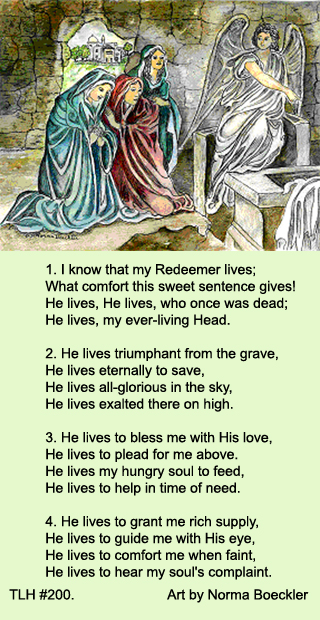
The Sermon Hymn #200                I Know that My Redeemer            1:80

How Christ Comes to Us

The Communion Hymn #187            Christ Is Arisen                     1:45
The Preface p. 24
The Sanctus p. 26
The Lord's Prayer p. 27
The Words of Institution
The Agnus Dei p. 28
The Nunc Dimittis p. 29
The Benediction p. 31
The Hymn # 195 (Luther)            Christ Jesus             1:46

First Sunday After Easter

Lord God, heavenly Father, we thank Thee, that of Thine ineffable grace, for the sake of Thy Son, Thou hast given us the holy gospel, and hast instituted the holy sacraments, that through the same we may have comfort and forgiveness of sin: We beseech Thee, grant us Thy Holy Spirit, that we may heartily believe Thy word; and through the holy sacraments day by day establish our faith, until we at last obtain salvation through Jesus Christ our Lord, who liveth and reigneth with Thee and the Holy Ghost, one true God, world without end. Amen.

KJV 1 John 5:4 For whatsoever is born of God overcometh the world: and this is the victory that overcometh the world, even our faith. 5 Who is he that overcometh the world, but he that believeth that Jesus is the Son of God? 6 This is he that came by water and blood, even Jesus Christ; not by water only, but by water and blood. And it is the Spirit that beareth witness, because the Spirit is truth. 7 For there are three that bear record in heaven, the Father, the Word, and the Holy Ghost: and these three are one. 8 And there are three that bear witness in earth, the Spirit, and the water, and the blood: and these three agree in one. 9 If we receive the witness of men, the witness of God is greater: for this is the witness of God which he hath testified of his Son. 10 He that believeth on the Son of God hath the witness in himself: he that believeth not God hath made him a liar; because he believeth not the record that God gave of his Son.

KJV John 20:19 Then the same day at evening, being the first day of the week, when the doors were shut where the disciples were assembled for fear of the Jews, came Jesus and stood in the midst, and saith unto them, Peace be unto you. 20 And when he had so said, he shewed unto them his hands and his side. Then were the disciples glad, when they saw the Lord. 21 Then said Jesus to them again, Peace be unto you: as my Father hath sent me, even so send I you. 22 And when he had said this, he breathed on them, and saith unto them, Receive ye the Holy Ghost: 23 Whose soever sins ye remit, they are remitted unto them; and whose soever sins ye retain, they are retained.

24 But Thomas, one of the twelve, called Didymus, was not with them when Jesus came. 25 The other disciples therefore said unto him, We have seen the Lord. But he said unto them, Except I shall see in his hands the print of the nails, and put my finger into the print of the nails, and thrust my hand into his side, I will not believe. 26 And after eight days again his disciples were within, and Thomas with them: then came Jesus, the doors being shut, and stood in the midst, and said, Peace be unto you. 27 Then saith he to Thomas, Reach hither thy finger, and behold my hands; and reach hither thy hand, and thrust it into my side: and be not faithless, but believing. 28 And Thomas answered and said unto him, My Lord and my God. 29 Jesus saith unto him, Thomas, because thou hast seen me, thou hast believed: blessed are they that have not seen, and yet have believed. 30 And many other signs truly did Jesus in the presence of his disciples, which are not written in this book: 31 But these are written, that ye might believe that Jesus is the Christ, the Son of God; and that believing ye might have life through his name.


How Christ Comes to Us

John 20:19 Then the same day at evening, being the first day of the week, when the doors were shut where the disciples were assembled for fear of the Jews, came Jesus and stood in the midst, and saith unto them, Peace be unto you.

The Gospel of John is extremely important for supplementing what we know about Christ from the first three Gospels. Whenever the Fourth Gospel tells us something that is not in the first three, we know that he—inspired by the Holy Spirit—knew this was essential for believers to know. Or, the Fourth Gospel adds essential details.

In some cases it was not necessary to repeat the narrative but to give more of Jesus’ teaching about the topic. For example, the Fourth Gospel may be the most sacramental of the Gospels, yet the baptism of Jesus and the Last Supper are not detailed. They are reflected upon but not described.

Some other characteristics of the Fourth Gospel are worth repeating:
  1. John has many long sermons from Jesus, unique to the Gospel, including the I AM passages.
  2. The Father-Son relationship is constantly emphasized.
  3. The geography is precise, so the author knew the area first-hand. We know he was the Apostle John.
  4. The purpose of the Gospel is to create faith, for believing in Christ is salvation.

Apostates want us to think that everyone is forgiven, everyone is saved. That is the foundational doctrine of the Left-wing mainline denominations, the Roman Catholic Church, and the Unitarian-Universalists. They imagine that all they need to do is say God is gracious, everyone is saved, join my church. WELS even had an “evangelism” banner that said that – “You are saved, just like me.” The DP who denied this, Jon Buchholz, also published the same bizarre dogma, in a convention essay “critical” of the Kokomo Statements.

KJV John 20:30 And many other signs truly did Jesus in the presence of his disciples, which are not written in this book: 31 But these are written, that ye might believe that Jesus is the Christ, the Son of God; and that believing ye might have life through his name.

In other words, the Gospel of John is written so that people hear about Christ, what He did and taught, so they might believe in Him, have forgiveness and salvation in His Name.

KJV Acts 4:12 Neither is there salvation in any other: for there is none other Name under heaven given among men, whereby we must be saved.

KJV John 14:6 Jesus saith unto him [doubting Thomas], I AM the way, the truth, and the life: no man cometh unto the Father, but by Me.

John 20:19 Then the same day at evening, being the first day of the week, when the doors were shut where the disciples were assembled for fear of the Jews, came Jesus and stood in the midst, and saith unto them, Peace be unto you.

Lenski put the situation into context:
Now the situation is the following. Ten of the eleven were together with a number of other disciples. The women who had met the angels and then had seen and heard Jesus early in the morning had brought this news. Peter and John had seen the strange sight in the tomb. Mary Magdalene had seen the angels and Jesus himself and had brought the message from him. What thus occurred in the morning of this wonderful day did not produce faith among the disciples (Luke 24:11 and v. 22, etc.), save the littleness of faith in John’s silent heart (v. 8). then came the appearance of Jesus to Peter (Luke 24:34; 1 Cor. 15:5), of which we know the fact and the effect but no details, not even the hour or the place. Finally came the report of the two disciples who had gone to Emmaus, Luke 24:35; when these two returned, joyful faith had already spread among all those gathered together. While the two from Emmaus are still speaking (Luke 24:36), Jesus appears to the entire company. Luke 24:36–48 and John 20:19–23 deal with the same event.[1]
Lenski, R. C. H.: The Interpretation of St. John's Gospel. Minneapolis, MN : Augsburg Publishing House, 1961, S. 1363.

KJV Luke 24:36 And as they thus spake, Jesus himself stood in the midst of them, and saith unto them, Peace be unto you. 37 But they were terrified and affrighted, and supposed that they had seen a spirit. 38 And he said unto them, Why are ye troubled? and why do thoughts arise in your hearts? 39 Behold my hands and my feet, that it is I myself: handle me, and see; for a spirit hath not flesh and bones, as ye see me have. 40 And when he had thus spoken, he shewed them his hands and his feet. 41 And while they yet believed not for joy, and wondered, he said unto them, Have ye here any meat? 42 And they gave him a piece of a broiled fish, and of an honeycomb. 43 And he took it, and did eat before them. 44 And he said unto them, These are the words which I spake unto you, while I was yet with you, that all things must be fulfilled, which were written in the law of Moses, and in the prophets, and in the psalms, concerning me. 45 Then opened he their understanding, that they might understand the scriptures, 46 And said unto them, Thus it is written, and thus it behoved Christ to suffer, and to rise from the dead the third day: 47 And that repentance and remission of sins should be preached in his name among all nations, beginning at Jerusalem. 48 And ye are witnesses of these things. 49 And, behold, I send the promise of my Father upon you: but tarry ye in the city of Jerusalem, until ye be endued with power from on high.

Locked Doors
The locked doors are significant, because they contrast the fear of the disciples and the power of Christ.

Fear is the opposite of faith, so we should turn to the Gospel Promises when we are fearful and anxious. And when we let fear take over, faith flies out the window.

Christ’s appearance is also important. He does not scatter the furniture, as Luther pointed out in discussing the fanatical sects. The Pentecostals of Luther’s time and ours want to have us think that conversion means leaving at once for Borneo or doing something else radical and disruptive, to prove this change.

Our hearts may be locked against all outside forces and the Gospel, but the Gospel penetrates the heart in spite of our hardness of heart. God does this in many ways, but always through the Word. Sometimes misfortune or the consequences of our actions make us distrustful of our own wisdom. Then we see the Gospel in a new light.

I hear many stories about people getting away from false teachers and abusive leaders, feeling the wounds and yet glad to hear the Gospel with a new appreciation.

The disciples, at this point, were carefully taught for three years, knowing and seeing what Christ predicted. And yet they were overwhelmed with fear and lacking in faith, which grew slowly. They stayed locked up for a week. Christ carefully nurtured them, berating their lack of faith but also building it up.

We experience that building up when we hear the Gospel, such as this blessing pronounced upon all of us – “Blessed are those who believe without seeing.” Jesus Himself pronounces this blessing upon us for believing in Him without having visible evidence, only the Word of God.

Every single liturgical service ends with a three-fold blessing. That should be not be taken as the end of the service but the beginning of a new week. “The Lord bless you and keep you…The Lord make His face to shine upon you and be gracious unto you…The Lord lift up His countenance upon you and give you peace. Numbers 6:24-25. [Schuller’s “God loves you and so do I” is rather tepid compared to the Trinitarian blessing, no?]

Just as we receive peace from God at the end of the service, Jesus began with granting peace to His disciples.

Peace is the primary greeting in Judaism. Jerusalem means a “place of peace,” a note of irony in history. Shalom is the peace greeting, still used. Peace is always associated with faith and salvation in the New Testament, because the forgiveness of sin brings peace.

The locked doors remind us that Christ was never bound by any kind of barrier in Creation, since His human nature was never limited by His divine nature. He passed through crowds several times in His public ministry. He left the tomb before it was empty. Nothing is sadder than resurrection art that shows His angels opening the tomb for Him. That would mean His creation (the angels) released Him from the stone tomb He created.

Gerhardt:
The Father offers up His Son!
The Son, content, descendeth!
O Love, how strong Thou art to save!
Thou beddest Him within the grave
Whose word the mountains rendeth. “A Lamb Goes Uncomplaining Forth”

This issue involves more than art. John Calvin had trouble with the Two Natures of Christ. In his commentary on John he had Jesus enter the locked room by a secret entrance. Others have Jesus hiding before He revealed Himself. Here is Calvinistic logic, which I find among the UOJ fanatics too – If Jesus could not leave the sealed tomb by Himself or enter the locked room, then He cannot be in the bread and wine of Holy Communion. Starting with a false assumption, anything can be stated as true when it is just the opposite.

Therefore, if someone asks, “How can the bread and wine also be the Body and Blood of Christ after consecration?” – the answer is in the locked room, the empty tomb, and the crowds that surrounded but did not impede Jesus.

One might as well ask, “How can God hear spoken or unspoken prayers?” One bit of rationalism leads to another. That is why rationalistic Christianity will lead one into Unitarianism. How can God be Three and yet One? These are all mysteries revealed by the Holy Spirit in the Word.

A Jehovah’s Witness said to me, “How can Jesus pray to God. That means God is praying to God. I can’t understand it.” I said, “Neither can my dog, but that does not mean it is false.” Rationalists have to change the Bible to fit their assumptions. JWs and UOJs are identitical that way. JWs have their own Bible, and the UOJ fanatics have the NNIV.


20 And when he had so said, he shewed unto them his hands and his side. Then were the disciples glad, when they saw the Lord.

When Jesus displayed His hand and side, they knew they were looking at their Teacher, the risen Lord. They knew the tomb was empty. Now they were filled with joy at seeing Him.
The resurrection appearances were the completion of the training of the apostles, the twelve main leaders (Judas was replaced) and the 500. Jesus taught them during this time to merge their Old Testament training with their Gospel message, so all those Old Testament passages, which they knew so well, became foundational for all they said about Jesus. That is also why the new congregations began with an Old Testament in Greek, to support Jewish Christians and to train non-Jewish Christians.

21 Then said Jesus to them again, Peace be unto you: as my Father hath sent me, even so send I you. 22 And when he had said this, he breathed on them, and saith unto them, Receive ye the Holy Ghost: 23 Whose soever sins ye remit, they are remitted unto them; and whose soever sins ye retain, they are retained.

This is the Office of the Keys, an essential work of the Christian Church. Jesus emphasized the apostles’ connection with Him, His connection with the Father. Just as He was sent by the Father to do His will, so He is sending the apostles to do the will of Christ. Granting forgiveness is one part of this work. Not granting forgiveness is another.

Someone said, “The retaining key is hanging, rusted, on the peg.” False doctrine is excused, forgiven, and even supported. The most heinous sins are covered up, denied, and even excused. Offering forgiveness to the unrepentant is the worst possible approach, because it hardens the heart of the recipient and it also damages the soul of the cheap-grace giver.

When people ask about children growing up to be sociopaths, the answer is often the neglect of the parents and taking the easy way out. Excusing and protecting bad behavior only makes it worse, and soon the parents share the evil by protecting it.

That is even more true of church officials, who should be guarding sound doctrine instead of promoting Fuller Seminary opinions and criminal church workers.

Arkansas fired their coach immediately for unethical and immoral conduct, which also reflected poorly on the school, but the Missouri Synod DPs allowed a convicted sex offender (his step-daughter was 13 years old) to become a “lay pastor” even though he was thrice-divorced  - so he could molest another minor in a congregation. Moreover, the officials had the earlier news report, heard his own rather self-serving confession, and still encouraged him to become a “lay pastor.” When their felonious behavior became public on Steadfast Lutherans, the slavering jaws and raking claws appeared from beneath the ovine fleece they wore. All discussion was banned because—get this—it was sinful to question their leadership.

24 But Thomas, one of the twelve, called Didymus, was not with them when Jesus came. 25 The other disciples therefore said unto him, We have seen the Lord. But he said unto them, Except I shall see in his hands the print of the nails, and put my finger into the print of the nails, and thrust my hand into his side, I will not believe.

Doubting Thomas is worth following in the Fourth Gospel. He has some of the best lines, as they say. He wondered how anyone could know the way Jesus was going.

KJV John 14:5 Thomas saith unto him, Lord, we know not whither thou goest; and how can we know the way?

Jesus responded, “I AM the way, the truth, and the life. No one comes to the Father except through Me.”

When Christians wonder if Jesus is indeed the only way of salvation, I quote them this response and ask if they can find an exception to “No one comes to the Father except through Me.”

Another choice saying is Thomas suggesting that in going toward Jerusalem, to help Lazarus, they can all die together.

KJV John 11:16 Then said Thomas, which is called Didymus, unto his fellowdisciples, Let us also go, that we may die with him.

No one stated his doubts more clearly than Thomas, but that does not mean the others were free from this problem. Nor are we.

This nickname, the Twin, is found only in John. So is this great narrative of Jesus returning and offering to have His wounds seen and touched by Thomas.

When Jesus returned a week later (marked by this Sunday), He commanded Thomas to do what Thomas asked. Lenski made a good point about this.

Lenski:
But the situation does not turn on such an alternative. The decisive factor is the command of Jesus. It is couched in two peremptory imperatives. It is not Thomas who deliberately does what he said he would have to do before he believed; it is Jesus who now demands that he do this very thing. Those aorist imperatives compel Thomas to do what he now would gladly not do. These two imperatives tell us that Thomas did what he was thus commanded to do. John does not need to add another word. By compelling Thomas to use his finger and his hand as bidden Jesus is not punishing him. Far from it. A week ago he had commanded the other disciples in the same way: “Handle me and see; for a spirit hath not flesh and bones, as ye see me have,” Luke 24:39. That the disciples had, indeed, handled Jesus as these two aorist imperatives in Luke plainly imply is evidenced by 1 John 1:1, “and our hands have handled of the Word of life.” That which Jesus considered vital for the other disciples in order to make them “witnesses” in the fullest sense he certainly would not now allow Thomas to fail to do. He was now made a witness to the same extent as the others. Jesus looked far ahead in this insistence with regard to Thomas.
Lenski, R. C. H.: The Interpretation of St. John's Gospel. Minneapolis, MN: Augsburg Publishing House, 1961, S. 1388.

Jesus revealed a number of times that He was not a ghost, a dream, a vision, an apparition. This is important for remembered the concept of the Two Natures of Christ.

Once He was conceived by the Holy Spirit in the Virgin Mary, the Two Natures (divine and human) were united in One Person. Although He seemed to die only as a human, He died as the innocent Lamb of God, paying for the sins of the world. When He rose from the dead, His body bore the marks of His death, but His human nature did not limit His divine nature in any way. Thus He left the sealed tomb and entered the locked room.

Thus He is also present in both natures in the consecrated elements of Holy Communion. When we pray to Him, He hears our prayers and helps us in our weaknesses, because He was tempted in every way (without sinning), so He is our Mercy Seat.

Doubting Thomas needs a postscript, because he—of all the apostles—conquered the most blatant and audacious unbelief. He ignored the witness of all his fellow disciples and declared a faith that would be supported only by seeing and touching those wounds.

Thomas is considered by Christians in India as their apostle. According to tradition he preached the Gospel there. One province of the sub-continent is mostly Christian, so they call their church body Mar-Thoma, after Thomas.

The Gospel is not against Thomas but for us:

KJV Isaiah 53:6 All we like sheep have gone astray; we have turned every one to his own way; and the LORD hath laid on him the iniquity of us all.

28 And Thomas answered and said unto him, My Lord and my God. 29 Jesus saith unto him, Thomas, because thou hast seen me, thou hast believed: blessed are they that have not seen, and yet have believed.

I often despair of getting through to Lutherans, who deny what Luther wrote (but use his name), who reject the teaching of the Book of Concord (while calling themselves “confessional Lutherans”).
Lenski has a good paragraph on unbelief. He fought against his little American Lutheran Church (1930 merger) going weak in inerrancy. They silenced him, even though he was a former district president, former pastor, former seminary professor, and honored author and magazine editor. The 1930 merger weakened their stance on the Scriptures and the next version of the ALC in 1960 did even more damage, leading to the 1987 ELCA merger.

Lenski:
Unbelief always was and always will be unreasonable. This is glaringly plain in the case of Thomas. For him all this unanimous testimony of all these people, whose character for veracity he knew so well, amounts to nothing. The fact that all of them, like himself, had never dreamed of Jesus’ resurrection, had thought it impossible, and had then been convinced from this unbelief by overwhelming evidence, affects Thomas in an opposite way: he determines to set himself against them all. The more they speak to him and the more they present the facts, the more stubborn Thomas becomes. He has been called “doubting Thomas,” but he does not doubt, he is openly unbelieving. He challenges the evidence the others present. They have only seen—seeing does not count. If he is to believe he demands two lines of evidence, seeing plus feeling with his own finger and his own hand. And even the feeling must be twofold, that of the holes in Jesus’ hands and that of the gash in his side. Thomas demands what he deems a real test. What the other disciples claim to have is not nearly enough for him. Here the silliness of unbelief comes to view. If sight can be deceived, sight which takes in so much, what assurance has Thomas that feeling, which takes in far less, will not also be deceived?
Lenski, R. C. H.: The Interpretation of St. John's Gospel. Minneapolis, MN: Augsburg Publishing House, 1961, S. 1380.

The Word of God belongs to Him alone. We do not have the freedom to change it to suit ourselves or to stay employed by unbelievers. Nevertheless, because the Word belongs to Him alone, we can trust that sowing this living Word will always bring His results, will always prosper His work, will never return to Him void.

30 And many other signs truly did Jesus in the presence of his disciples, which are not written in this book: 31 But these are written, that ye might believe that Jesus is the Christ, the Son of God; and that believing ye might have life through his name.

The Bible has only one purpose – to convey Christ to us through the Gospel, from Genesis through Revelation. The Gospel produces faith and sustains faith, which receives the grace of God in the forgiveness of sin.

19. The leading thought, however, for us to learn and retain from this Gospel is, that we believe that Christ's resurrection is sure and that it works in us so that we be resurrected both from sin and death; as St. Paul richly and consolingly speaks of it, and Christ himself here, when he says: "Blessed are they that have not seen, and yet have believed," and St. John concluding this Gospel teaches and admonishes about the use and benefit of the resurrection: "These are written, that ye may believe that Jesus is the Christ, the Son of God; and believing ye may have life in his name."

20. This is indeed a powerful and clear passage, which highly praises faith and gives the testimony that we certainly have eternal life through the same; and that this faith is not an empty, dead thought on the history about Christ, but that which concludes and is sure that he is the Christ, that is, the promised King and Saviour, God's Son, through whom we all are delivered from sin and eternal death; for which purpose he also died and rose again; and that we alone for his sake acquire eternal life, in a way that is called in his name, not in Moses' nor in our nor any other man's name, that is, not because of the law, nor of our worthiness and doings, but alone on account of Christ's merits, as Peter says in Acts 4, 12: "There is none other name among men, wherein we must be saved," etc.

Quotations

"Thus we have two parts, preaching and believing.  His coming to us is preaching; His standing in our hearts is faith.  For it is not sufficient that He stand before our eyes and ears; He must stand in the midst of us in our hearts, and offer and impart to us peace."
            Sermons of Martin Luther, 8 vols., ed., John Nicholas Lenker, Grand Rapids:  Baker Book House, 1983, II,  p. 355.               

"This is going through closed doors, when He comes into the heart through the Word, not breaking nor displacing anything.  For when the Word of God comes, it neither injures the conscience, nor deranges the understanding of the heart and the external senses; as the false teachers do who break all the doors and windows, breaking through like thieves, leaving nothing whole and undamaged, and perverting, falsifying and injuring all life, conscience, reason, and the senses.  Christ does not do thus."
            Sermons of Martin Luther, II, p. 355. 

"Hence I send you into the world as my Father hath sent me; namely, that every Christian should instruct and teach his neighbor, that he may also come to Christ.  By this, no power is delegated exclusively to popes and bishops, but all Christians are commanded to profess their faith publicly and also to lead others to believe."
            Sermons of Martin Luther, II, p. 359.   
          
"The first and highest work of love a Christian ought to do when he has become a believer, is to bring others also to believe in the way he himself came to believe.  And here you notice Christ begins and institutes the office of the ministry of the external Word in every Christian; for He Himself came with this office  and the external Word."
            Sermons of Martin Luther, II, p. 359.

"Now God drives us to this by holding the law before us, in order that through the law we may come to a knowledge of ourselves.  For where there is not this knowledge, one can never be saved.  He that is well needs no physician; but if a man is sick and desires to become well, he must know that he is weak and sick, otherwise he cannot be helped."
            Sermons of Martin Luther, II, p. 370. 

"For the devil will not allow a Christian to have peace; therefore Christ must bestow it in a manner different from that in which the world has and gives, in that he quiets the heart and removes from within fear and terror, although without there remain contention and misfortune."
            Sermons of Martin Luther, II, p. 380.   
               
"Reformed theologians, in order to support their denial of the illocalis modus subsistendi of Christ's human nature, have sought, in their exposition of John 20, an opening in the closed doors, or a window, or an aperture in the roof or in the walls, in order to explain the possibility of Christ's appearance in the room where the disciples were assembled."
            Francis Pieper, Christian Dogmatics, 3 vols., St. Louis:  Concordia Publishing House, 1950, II, p. 127.


Friday, April 13, 2012

Luther's Sermon for the Sunday after Easter.
John 20:19-31


Sermon for the Sunday after Easter; John 20:19-31

A Sermon by Martin Luther; taken from his Church Postil.

[The following sermon is taken from volume II:354-363 of The Sermons of Martin Luther, published by Baker Book House (Grand Rapids, MI). It was originally published in 1906 in english by Lutherans in All Lands Press (Minneapolis, MN), as The Precious and Sacred Writings of Martin Luther, vol. 11.]


1. This Gospel praises the fruit of faith, and illustrates its nature and character. Among the fruits of faith are these two: peace and joy, as St. Paul writes to the Galatians, where he mentions in order all kinds of fruit saying: "But the fruit of the Spirit is love, joy, peace, longsuffering, kindness, goodness, faithfulness, meekness, self-control." Gal 5, 22. Thus these two fruits are also mentioned in our text. In the first place, Christ stands there among the disciples, who sit in fear and terror, and whose hearts are greatly troubled every hour expecting death; to them he comes and comforts them, saying: "Peace be unto you." This is one fruit. In the second place there follows from this sweet word the other fruit, that they were glad when they saw the Lord. Then he further bestows upon faith power and authority over all things in heaven and on earth, and truly extols it in that he says: "As the Father hath sent me, even so send I you." And again: "Receive ye the Holy Spirit: whose soever sins ye forgive, they are forgiven unto them; whose soever sins ye retain, they are retained." Let us now consider each thought in order.

2. Faith, as we have often said, is of the nature, that every one appropriates to himself the resurrection of the Lord Jesus Christ, of which we have already said enough; namely, that it is not sufficient simply to believe Christ rose from the dead, for this produces neither peace nor joy, neither power nor authority; but you must believe that he rose for your sake, for your benefit, and was not glorified for his own sake; but that he might help you and all who believe in him, and that through his resurrection sin, death and hell are vanquished and the victory given to you.

3. This is signified by Christ entering through closed doors, and standing in the midst of his disciples. For this standing denotes nothing else than that he is standing in our hearts; there he is in the midst of us, so that he is ours, as he stands there and they have him among them. And when he thus stands within our hearts, we at once hear his loving voice saying to the troubled consciences: Peace, there is no danger; your sins are forgiven and blotted out, and they shall harm you no more.


4. And this entrance the Lord made here through barred doors, going through wood and stone, and still leaving everything whole, breaking nothing, yet getting in among his disciples. This illustrates how the Lord comes into our hearts and stands in us, namely, through the office of the ministry. Therefore, since God has commanded men to preach his Word, one should in no wise despise a mortal man into whose mouth he has put his Word; lest we get the idea that every one must expect a special message from heaven, and that God should speak to him by the word of his mouth. For if he imparts faith to any one, he does it by means of the preaching of man and the external word of man.

This is going through closed doors, when he comes into the heart through the Word, not breaking nor displacing anything. For when the Word of God comes, it neither injures the conscience, nor deranges the understanding of the heart and the external senses; as the false teachers do who break all the doors and windows, breaking through like thieves, leaving nothing whole and undamaged, and perverting, falsifying and injuring all life, conscience, reason, and the senses. Christ does not do thus. Such now is the power of the Word of God. Thus we have two parts, preaching and believing. His coming to us is preaching; his standing in our hearts is faith. For it is not sufficient that he stands before our eyes and ears; he must stand in the midst of us in our hearts, and offer and impart to us peace.

5. For the fruit of faith is peace; not only that which one has outwardly, but that of which Paul speaks to the Philippians (4, 7) saying it is a peace that passeth all reason, sense and understanding. And where this peace is, one shall not and cannot judge according to reason. This we shall see still farther in our Gospel lesson.

6. First, the disciples sit there behind barred doors in great fear of the Jews, afraid to venture outside, with death staring them in the face. Outwardly they indeed have peace, no one is doing them any harm; but inwardly their hearts are troubled, and they have neither peace nor rest. Amid their fear and anguish the Lord comes, quiets their hearts and makes them glad, so that their fear is removed, not by removing the danger, but in that their hearts were no more afraid. For thereby the malice of the Jews is not taken away, nor changed; they rave and rage as before, and outwardly everything remains the same. But they are changed inwardly, receiving such boldness and joy as to declare: "We have seen the Lord." Thus he quiets their hearts, so that they become cheerful and fearless, not caring how the Jews rage.


7. This is the true peace that satisfies and quiets the heart; not in times when no adversity is at hand, but in the midst of adversity, when outwardly there is nothing but strife before the eyes. And this is the difference between worldly and spiritual peace. Worldly peace consists in removing the outward evil that disturbs the peace; as when the enemies besiege a city there is no peace; but when they depart peace returns. Such is the case with poverty and sickness. While they afflict you, you are not contented; but when they are removed and you are rid of the distress, there is peace and rest again from without. But he who experiences this is not changed, being just as fainthearted whether the evil be present or not; only he feels it and is frightened when it is present.


8. Christian or spiritual peace, however, just turns the thing about, so that outwardly the evil remains, as enemies, sickness, poverty, sin, death and the devil. These are there and never desist, encompassing us on every side; nevertheless, within there is peace, strength and comfort in the heart, so that the heart cares for no evil, yea, is really bolder and more joyful in its presence than in its absence. Therefore it is peace which passeth and transcendeth all understanding and all the senses. For reason can not grasp any peace except worldly or external peace, for it can not reconcile itself to it nor understand how that is peace if evil is present, and it knows not how to satisfy and comfort a person; hence it thinks if the evil depart, peace departs also. When however the Spirit comes, he lets outward adversity remain, but strengthens the person, making the timid fearless, the trembling bold, changing the troubled into a quiet, peaceful conscience, and such an one is bold, fearless and joyful in things by which all the world otherwise is terrified.

9. Whence does he receive this? From his faith in Christ. For if I truly believe in the Lord from the real depth of my heart, that my heart can truly say: My Lord Christ has by his resurrection conquered my need, my sin, death and all evil, and will be thus with and in me, so that body and soul shall want nothing, that I shall have all I need, and no evil shall harm me: if I believe this, it is impossible for me to be faint-hearted and timid no matter how much sin and death oppress me. For faith is ever present and says: Does sin burden you, does death terrify you, look to Christ who died for your sake and rose again, and conquered every evil; what can harm you? Why will you then fear? So also in case other misfortunes burden you, as sickness or poverty, turn your eyes from it, lock the door to reason and cast yourself upon Christ and cleave to him, so shall you be strengthened and comforted. If you look to Christ and believe on him, no evil that may befall you is so great that it can harm you and cause you to despair. Therefore it is impossible for this fruit to remain outside, where faith is, so that peace does not follow.

10. From peace the other fruit now follows, as is taught in this Gospel. When Christ came to the disciples and said: "Peace be unto you!" and showed them his hands and feet; then they were glad that they saw the Lord. Yes, to be sure they had to be glad, for that they saw Christ was the greatest joy the heart of man can experience. Hitherto we have been permitted to see our hands, that is, we have been taught to trust in our works; this brought no gladness. But to see Christ makes us glad. And this takes place by faith; for thus St. Paul in Rom 5,1-2 says: "Being therefore justified by faith, we have peace with God through our Lord Jesus Christ; through whom also we have had our access by faith into this grace wherein we stand; and we rejoice in hope of the glory of God."

11. Thus we have the fruit whereby we know who are true Christians. For he who has no peace in that in which the world finds nothing but unrest, and is joyful in that which in the world is nothing but gloom and sorrow, is not yet a Christian, and does not yet believe. This truth is being also sung at this season everywhere in the hymn on the Lord's resurrection; but hardly anybody understands it. He who composed it surely understood it aright. He does not stop at the Lord is risen, when he says: "Christ is risen from his Passion;" as though this were sufficient, but brings it home to us and adds: Let us all rejoice in this. But how can we rejoice in it, if we have nothing of it and it is not ours? Therefore, if I am to rejoice in it, it must be mine, that I may claim it as my own property, that it may profit me. And finally he closes: Christ will be our consolation, that we can and shall have no other consolation but Christ. He wants to be it himself and he alone, that we should cling to him in every time of need; for he has conquered all for our benefit, and by his resurrection he comforts all troubled consciences and sad hearts. This the Gospel teaches concerning faith and its fruits.

12. Now follows the office of the ministry. The power of faith now develops love. For it does not yet suffice that I have the Lord so that he is mine, and that I find in him all comfort, peace and joy; but I must henceforth also do as he has done: for it follows thus in the text:

"As the Father hath sent me, even so send I you."

13. The first and highest work of love a Christian ought to do when he has become a believer, is to bring others also to believe in the way he himself came to believe. And here you notice Christ begins and institutes the office of the ministry of the external Word in every Christian; for he himself came with this office and the external Word. Let us lay hold of this, for we must admit it was spoken to us. In this way the Lord desires to say: You have now received enough from me, peace and joy, and all you should have; for your person you need nothing more. Therefore labor now and follow my example, as I have done, so do ye. My Father sent me into the world only for your sake, that I might serve you, not for my own benefit. I have finished the work, have died for you, and given you all that I am and have; remember and do ye also likewise, that henceforth ye may only serve and help everybody, otherwise ye would have nothing to do on earth. For by faith ye have enough of everything. Hence I send you into the world as my Father hath sent me; namely, that every Christian should instruct and teach his neighbor, that he may also come to Christ. By this, no power is delegated exclusively to popes and bishops, but all Christians are commanded to profess their faith publicly and also to lead others to believe.

14. Secondly, if you have exercised yourself in this highest work and taught others the right way of truth, then make up your mind to keep on and serve everybody. Then the example of your life and good works follows; not that you can thereby merit and acquire anything, seeing you have beforehand everything that is necessary to salvation. Furthermore Christ now gives a command, he breathes upon the disciples and says:

"Receive ye the Holy Spirit: whose soever sins ye forgive, they are forgiven unto them; whose soever sins ye retain, they are retained."

15. This is a great and mighty power which no one can sufficiently extol, given to mortal men of flesh and blood over sin, death and hell, and over all things. The pope too boasts in the canon law that Christ has given to him power over all earthly things; which would indeed be correct if the people rightly understood it. For they apply it to the civil government; this is not Christ's thought; but he gives spiritual power and rule, and wishes to say this much: When ye speak a word concerning a sinner, it shall be spoken in heaven, and shall avail so much as if God himself spake it in heaven; for he is in your mouth, therefore it has the same force as if he himself spoke it. Now it is always true, if Christ speaks a word, since he is Lord over sin and hell, and says to you: Thy sins are forgiven; then they must be forgiven and nothing can prevent it. Again, if he says: Thy sins shall not be forgiven thee; then they remain unforgiven, so that neither you, nor an angel, nor a saint, nor any creature, can forgive your sin, even if you martyred yourself to death.

16. This same power belongs to every Christian, since Christ has made us all partakers of his power and dominion; and here his is not a civil but a spiritual rule, and his Christians also rule spiritually. For he does not say: This city, this country, this bishopric or kingdom you shall rule, as the pope does; but he says: Ye shall have power to forgive and to retain sins. Hence this power pertains to the conscience, so that by virtue of God's Word I can pass judgment as to what the conscience can cleave to, so that against and above that no creature can do anything, neither sin, nor the world nor Satan. This is true power. But thereby no power is given me to rule over temporal matters, over a country and people, externally after the manner of civil governments, but a much higher and nobler power, which can in no sense be compared with it.


17. Therefore we shall thank God, that we now know the great power and glory given us through Christ in his plain Word, as St. Paul also highly praises and extols it to the Ephesians, saying: "Blessed be the God and Father of our Lord Jesus Christ, who hath blessed us with every spiritual blessing in the heavenly places in Christ." Eph 1, 3. And again: "God made us alive together with Christ, and raised us up with him, and made us sit with him in heavenly places, in Christ Jesus: that in the ages to come he might show the exceeding riches of his grace in kindness toward us in Christ Jesus: for by grace have ye been saved through faith; and that not of yourselves, it is the gift of God; not of works, that no man should glory. For we are his workmanship, created in Christ Jesus for good works, which God afore prepared that we should walk in them." Eph 2,5-10.

18. Observe, what great transcendent comfort we have in that God awakens in us also the same power he exercises in Christ, and bestows upon us equal authority. As he made him sit in heavenly places, above all power and might, and everything that can be named; so has he invested us also with the same power, that those who believe have all power over heaven and earth. This we have in the words he left behind him; and they are so powerful, that when they are spoken by us, they avail as much as if he himself were on earth and spake them in the majesty and glory in which he now exists. And this is the power we have from his resurrection and ascension; there he gives us power to, kill and to make alive, to consign to the devil and to rescue from him.

19. But in this matter one must proceed carefully, and not do like the popes. For they have reached the point to have the power, that however and whatever they say, so it must be, because they say it. Nay, this power you have not, but the divine Majesty alone has it. They say thus: If the pope speaks a word and says: Thy sins are forgiven thee, they are blotted out, even though you neither repent nor believe. They mean by this, that they have the power to bestow and withhold heaven, to open or shut it, to locate one in heaven or cast into hell; far from it that it should be so. For from this it would then follow that our salvation depended on the works, authority and power of man. Therefore, since this is in conflict with all the Scriptures it can not be true that when you open or shut, it must be open or shut.

20. Therefore we must rightly understand Christ when he says: "Whose soever sins ye forgive, they are forgiven unto them; whose soever sins ye retain, they are retained;" that this does not establish the power of him who speaks but of those who believe. Now the power of him who speaks and of him who believes are as far apart as heaven and earth.

God has given us the Word and the authority to speak; but it does not therefore follow from this that it must so be done, as Christ also preached and taught the Word, and yet not all who heard it believed, and it was not everywhere done as he spake the Word, although it was God's Word. Therefore Christ's meaning is: Ye shall have the power to speak the Word, and to preach the Gospel, saying, Whosoever believeth, has the remission of his sins; but whosoever believeth not, has no remission of sin. But ye have not the power to create faith. For there is a great difference between planting and giving the growth; as Paul says to the Corinthians: "I planted, Apollos watered; but God gave the increase." 1 Cor 3, 6. Hence we have no authority to rule as lords; but to be servants and ministers who shall preach the Word, by means of which we incite people to believe. Therefore, if you believe the Word, you gain this power; but if you believe not, then what I speak or preach will avail nothing even though it be God's Word; and if you believe not these words you are not treating me but God himself with dishonor and contempt.


21. Therefore, unbelief is nothing but blasphemy, which makes God a liar. For if I say, your sins are forgiven
you in God's name, and you believe it not, it is the same as if you said: who knows whether it be true, and whether he be in earnest? By this you charge God and his Word with lying. Therefore you better be far from the Word, if you believe it not. For when a man preaches his Word, God would have it as highly esteemed as if he himself had preached it. This then is the power given by God, which every Christian has, and of which we have already spoken much and often; hence this is enough for the present.


Sunday, April 8, 2012

Marine reflects on being the voice of Bambi - Houston Chronicle


Marine reflects on being the voice of Bambi - Houston Chronicle:


After decades of silence, a tough Marine has come forward with his clean little secret: He's the voice of Bambi.

San Antonio native Donnie Dunagan, now of San Angelo, was 6 when Walt Disney hired him to be the model and voice of the fawn in the 1942 animated classic, which debuted on DVD last week.

During his entire military career, Dunagan never confided to colleagues about being in Bambi.

"I was blessed to be in a leadership role for 25 years, either in counterintelligence or training troops," Dunagan said, "and if these animals I was leading had ever found out about Bambi — as much affection as I had for it — they'd have ridden me out on a rail."

Since he's come forward, though, he's taking renewed pride in his role.

"I go down the street now, and when some old Marine who knew me before yells, 'Hey, Major Bambi!' I love it to death," Dunagan said.

Dunagan made eight movies as a child after being discovered at a Memphis, Tenn., talent show. They included 1939's Son of Frankenstein with Boris Karloff and Tower of London with Basil Rathbone. But his career ended when his family fractured. He wound up in boarding homes, then joined the military as a teen.

"I adopted the Marines, and the Marines adopted me," Dunagan said.

Dunagan distinguished himself in the service. The curly-haired lad with the Southern drawl whom Karloff had hoisted on a monster's shoulder became the youngest Marine drill instructor ever. A boxer and devoted Harley rider, Dunagan served three tours in Vietnam and was wounded several times.

After leaving the Marines in 1977, he worked in business and kept mum about his childhood stardom, even as fans scoured phone books for him.

But Dunagan was nailed last June. A casual comment at a San Angelo banquet tipped off a local TV crew that they had a star in their midst.

Dunagan, 70, and Dana, his wife of 13 years, had moved to the town two years before so his stepson could attend college there. Only after his story came out "did we open the old boxes I'd sealed for 50 years, with newspaper clippings about my time in Bambi."

Disney contacted him soon after about participating in a DVD of Bambi. Dunagan appears in a featurette about the cast, then and now. He was always fond of the film and showed videocassettes of it to children whenever he could. Now he's getting DVD copies from Disney to give to orphanages.

Having come to terms with it, the Marine who was Bambi finally is speaking up.

This year Dunagan will make his first appearances at film fan conventions, to meet admirers and sign autographs.

"His autograph hasn't been out there since he was 4 or 5," said Donna Lucas, publisher — with husband Tim Lucas — of Video Watchdog, which ran a cover story on Dunagan in October.

Fans are ecstatic that he's finally come forward, she said. "This is one of the last living people who worked with Karloff, and he's got an incredible memory."

Though Dunagan loathes self-promotion, he finally allowed his wife to launch a Web site, www.donniedunagan.com, where he shares happy memories of kidding with Karloff and roaming Disney's studio.

"Mr. Disney was a positive, real leader. He was all over, doing everything. He had his sleeves rolled up, and people respected him and were happy.

"I knew there were phonies in show business, but not there, not at Disney. I think Mr. Disney was a pioneer — as a humanist, an environmentalist and an artist."

Disney encouraged naturalism in the kids. For a scene in which Bambi grimaces after being kissed by young deer Faline, "He told me to pretend I'd taken castor oil and make a face," Dunagan said. "I had to hold expressions of fear, happiness, joy or anger while the artists drew it."

He credits Disney for hiring children to voice small animals, instead of casting adults who'd use childlike voices. To this day, Dunagan hasn't met his co-stars, who recorded their lines separately.

Dunagan saw Bambi before its original release and was surprised by its most notorious scene: when Bambi's mother is killed by hunters off-screen.

"That was the only thing that bothered me," he said. "Nobody told me when I recorded the line 'Mother! Mother!' what it was about. But back then, there was a war going on, and a lot of children's mothers were dying. I think it was very, very smart to have it happen off-camera."

Dunagan is semiretired today. He lost his savings in the Enron debacle and has been tutoring and "doing what I can do." He says he'd "give you push-ups in the street" to get back into show business, as a performer or a technical adviser.

And the tough guy from Texas has a special place in his heart for the tender Bambi.

"Is there any incongruity in being a tough old Marine and loving Bambi? No, no," Dunagan said.

"I'm a sensitive man. When I had my first casualties as a lieutenant, I had a hard time controlling my emotions, but I had a strong sergeant with me who kept me from doing something stupid.

"I've been around some real tough guys, and I promise you on my honor: The strongest guys I've known in life would pick up a wounded baby kitty on the side of the road. Yet you wouldn't want to go against them in combat. That is not inconsistent. It is part of the same ethos."


'via Blog this'

Saturday, April 7, 2012

Easter Sunday, April 8, 2012


Easter Sunday: The Feast of the Resurrection of Our Lord - 2012


Pastor Gregory L. Jackson


The Hymn #191               Christ the Lord                      2:97
The Confession of Sins
The Absolution
The Introit p. 16
The Gloria Patri
The Kyrie p. 17
The Gloria in Excelsis
The Salutation and Collect p. 19
The Epistle and Gradual       
The Gospel              
Glory be to Thee, O Lord!
Praise be to Thee, O Christ!
The Nicene Creed p. 22
The Sermon Hymn #188                Hallelujah                   2:20 

 Faith versus Feelings

The Communion Hymn # 206:1-5            Jesus Christ, My Sure Defense  2:81
The Preface p. 24
The Sanctus p. 26
The Lord's Prayer p. 27
The Words of Institution
The Agnus Dei p. 28
The Nunc Dimittis p. 29
The Benediction p. 31
The Hymn #189   He Is Arisen Glorious Word               4:77

KJV 1 Corinthians 5:6 Your glorying is not good. Know ye not that a little leaven leaveneth the whole lump? 7 Purge out therefore the old leaven, that ye may be a new lump, as ye are unleavened. For even Christ our passover is sacrificed for us: 8 Therefore let us keep the feast, not with old leaven, neither with the leaven of malice and wickedness; but with the unleavened bread of sincerity and truth.

KJV Mark 16:1 And when the sabbath was past, Mary Magdalene, and Mary the mother of James, and Salome, had bought sweet spices, that they might come and anoint him. 2 And very early in the morning the first day of the week, they came unto the sepulchre at the rising of the sun. 3 And they said among themselves, Who shall roll us away the stone from the door of the sepulchre? 4 And when they looked, they saw that the stone was rolled away: for it was very great. 5 And entering into the sepulchre, they saw a young man sitting on the right side, clothed in a long white garment; and they were affrighted. 6 And he saith unto them, Be not affrighted: Ye seek Jesus of Nazareth, which was crucified: he is risen; he is not here: behold the place where they laid him. 7 But go your way, tell his disciples and Peter that he goeth before you into Galilee: there shall ye see him, as he said unto you. 8 And they went out quickly, and fled from the sepulchre; for they trembled and were amazed: neither said they any thing to any man; for they were afraid.

Easter

Lord God, heavenly Father, who didst deliver Thy Son for our offenses, and didst raise Him again for our justification: We beseech Thee, grant us Thy Holy Spirit, that He may rule and govern us according to Thy will; graciously keep us in the true faith; defend us from all sins, and after this life raise us unto eternal life, through the same, Thy beloved Son, who liveth and reigneth with Thee and the Holy Ghost, one true God, world without end. Amen.


Faith versus Feelings

Mark 16:1 And when the sabbath was past, Mary Magdalene, and Mary the mother of James, and Salome, had bought sweet spices, that they might come and anoint him.

Lenski points out that the women came to the tomb very early to finish the work they wished to do. Jesus died on Friday, so sundown was the Sabbath. After the Sabbath was over, Saturday evening, they had a little time to buy the expensive spices in liquid form. Powdered spices were used with the linen wraps (also expensive) that Joseph of Arimathea provided.

KJV Mark 15:43 Joseph of Arimathaea, an honourable counsellor, which also waited for the kingdom of God, came, and went in boldly unto Pilate, and craved the body of Jesus. 44 And Pilate marvelled if he were already dead: and calling unto him the centurion, he asked him whether he had been any while dead. 45 And when he knew it of the centurion, he gave the body to Joseph. 46 And he bought fine linen, and took him down, and wrapped him in the linen, and laid him in a sepulchre which was hewn out of a rock, and rolled a stone unto the door of the sepulchre.

The Gospel of John records that Nicodemus, who came to Him by night (Nick at Night – John 3) was also involved in the burial, so faith overcame fear, in spite of Nicodemus high standing with the religious leaders and the criminal reputation of Jesus.

The women came to the tomb very early on Sunday, before the sun was up. Sunday, in the Jewish reckoning, began Saturday evening.

Some have trouble with “after three days” because we think in Western terms, with 24 hours being a day. Jewish reckoning counted each part of a day as a separate day, so Jesus died on Friday, was in the tomb Saturday, and rose on the third day, which could have included Saturday in our time.

That is why many denominations have an Easter Vigil very late on Saturday, reciting the Scriptures of the Bible. In Moline we had sunrise services, but the Greek Orthodox had Easter Vigil, which we attended at least once, as college students who knew some Greek.

2 And very early in the morning the first day of the week, they came unto the sepulchre at the rising of the sun.

Certain women were named in this group visiting the tomb. No men were present at this time. They were anxious to honor their dead Teacher, and they also wanted to speedy due to the effects of desert heat. (Note the contrast with Lazarus, when Jesus deliberately delayed His visit, so people feared being near the tomb, due to rapid decomposition.)

3 And they said among themselves, Who shall roll us away the stone from the door of the sepulchre?

On the way they realized that they did not make plans for removing the stone lid from the tomb. The closing of the tomb was more of a lid that rolled in a groove. A boulder to fit the opening would have defied movement by several men. But a stone lid might be muscled aside by several men – not by the women.

Luther describes the condition of the women as being overcome with emotion and grief. When we are in that condition we are not going to think are plan carefully. The crisis of the moment fills our minds. They were rushing to do what women normally did at that time. There were prescribed rituals, which are still followed in many cultures.

Mark does not deal with the soldiers guarding the tomb. We have four narratives, plus additional details from Paul, so we have a complete picture from all of them. Roman soldiers were posted to guard the tomb, but they fled when the earthquake opened the tomb and showed it to be empty.

Why soldiers? Jesus was far more dangerous to the leaders than the liberals of today allow. He arrived in Jerusalem as a king, with the crowds hailing Him as the Messiah. He brought with Him Lazarus, who was proof of His ability to raise the dead – a claim no one else could make. The religious authorities were so anxious about Lazarus that they plotted against him, too.

The guards tell us that the civil authorities were sufficiently afraid, ironically bearing witness to Jesus’ power over death. They would make sure that nothing happened.

The litmus test of an apostate is the denial of the Virgin Birth and the physical resurrection of Christ. I have used that more than once. In 1987 I found only one ELCA seminary professor who could support the resurrection of Christ. That man conceded in print that it “probably happened.” But the fact remains that no one has ever denied the facts. They simply do not believe in the divinity of Christ, so that settles the question for them. It does not affect their concept of reality. They marvel that the disciples loved Him so much that they believed it to be true.

My favorite response to the litmus test was from this Disciples of Christ seminary student – “Those are not important issues.” She bragged that the Unitarians studied at the same school. I said, “Why not?”

KJV John 12:1 Then Jesus six days before the passover came to Bethany, where Lazarus was which had been dead, whom he raised from the dead. 2 There they made him a supper; and Martha served: but Lazarus was one of them that sat at the table with him. 3 Then took Mary a pound of ointment of spikenard, very costly, and anointed the feet of Jesus, and wiped his feet with her hair: and the house was filled with the odour of the ointment. 4 Then saith one of his disciples, Judas Iscariot, Simon's son, which should betray him, 5 Why was not this ointment sold for three hundred pence, and given to the poor? 6 This he said, not that he cared for the poor; but because he was a thief, and had the bag, and bare what was put therein. 7 Then said Jesus, Let her alone: against the day of my burying hath she kept this. 8 For the poor always ye have with you; but me ye have not always. 9 Much people of the Jews therefore knew that he was there: and they came not for Jesus' sake only, but that they might see Lazarus also, whom he had raised from the dead. 10 But the chief priests consulted that they might put Lazarus also to death; 11 Because that by reason of him many of the Jews went away, and believed on Jesus. 12 On the next day much people that were come to the feast, when they heard that Jesus was coming to Jerusalem, 13 Took branches of palm trees, and went forth to meet him, and cried, Hosanna: Blessed is the King of Israel that cometh in the name of the Lord. 14 And Jesus, when he had found a young ass, sat thereon; as it is written, 15 Fear not, daughter of Sion: behold, thy King cometh, sitting on an ass's colt. 16 These things understood not his disciples at the first: but when Jesus was glorified, then remembered they that these things were written of him, and that they had done these things unto him. 17 The people therefore that was with him when he called Lazarus out of his grave, and raised him from the dead, bare record.

4 And when they looked, they saw that the stone was rolled away: for it was very great.

Our prepositions are often vague, but German and Greek prepositions are exact. The stone lid, very large, was not rolled aside in the groove, but thrown away from the entrance, flat on the ground, never to be used again.

Matthew tells us that an angel rolled the stone away and sat on it. It was not rolled aside in its groove in the regular way so as to be rolled back again to shut the entrance. No, it was hurled out of its groove by some tremendous power, thrown flat upon the ground in front of the tomb, thus making a seat for the angel who waited until the women drew near and then went inside the tomb. This stone was not again to be rolled in front of the entrance. It had been laid flat so that the tomb should stand wide open for all men to see that it was emptied of the body of Jesus, the bodiless wrappings lying undisturbed and flat just as they had been wrapped, mute but mighty evidence of the resurrection, John 20:5–10.
When the women looked up they saw the stone in this condition; note the change of prepositions, not ἀπό in the verb as in v. 3 but ἀπά; not “away from” in the regular way, in the groove, but “back,” rolled violently from the cliffside. To have all this understood properly Mark explains (γάρ) that the stone in question was “very great.” Poorer tombs had small openings and needed smaller stones to close them; but this rich man’s tomb had an opening that was of full height and needed a stone of proportionate size for its closing. Gordon’s Tomb, described in 15:46, agrees perfectly with all that the evangelists say about the stone and the door.
The opening of the tomb by the angel has been misunderstood by some interpreters. When the angel opened the tomb, Jesus had already risen. None of the evangelists describes the resurrection proper; it had no witnesses, it was wholly miraculous. Jesus left the tomb silently. His dead body was suddenly quickened (1 Pet. 3:18), filled with life, and in the same instant passed out of its funeral wrappings and out through the walls of the sealed and guarded tomb invisible to the eyes of men. Then, when the tomb was empty, the angel came and opened the tomb to show that it was indeed empty. At this coming of the angel and the earthquake he caused the Roman guard fell prostrate and, recovering somewhat, fled. Those paintings which portray the glorious Savior coming out of the opened door of the tomb while the guard falls in dismay at the sight of him are not in accord with the facts of the case. Silently, invisibly, wondrously, gloriously the living body passed through the rock.
This mode of being is described well in Concordia Triglotta, 1004, 100: “The incomprehensible, spiritual mode, according to which he neither occupies nor vacates space, but penetrates all creatures, wherever he pleases; as, to make an imperfect comparison, my sight penetrates and is in air, light, or water, and does not occupy or vacate space; as a sound or tone penetrates and is in air or water or board or wall, and also does not occupy or vacate space; likewise, as light and heat penetrate and are in air, water, glass, crystal, and the like; and much more of the like. This mode he used when he rose from the closed sepulcher, and passed through the closed door, and in the bread and wine in the Holy Supper.”
Lenski, R. C. H.: The Interpretation of St. Mark's Gospel. Minneapolis, MN : Augsburg Publishing House, 1961, S. 740.

5 And entering into the sepulchre, they saw a young man sitting on the right side, clothed in a long white garment; and they were affrighted. 6 And he saith unto them, Be not affrighted: Ye seek Jesus of Nazareth, which was crucified: he is risen; he is not here: behold the place where they laid him.

This was a large tomb, which meant a very expensive one. They went in, so this was not an economy-sized carved tomb, but a large one. They saw an angel in a long white garment, sitting on the right side. Two angels were present, but one spoke.

Their immediate reaction, on seeing the stone lid thrown down, would have been to assume that tomb robbers had been there. Many people are buried with precious objects, or there is the hope that this would be true of a rich man’s grave.

The women rushed in afraid and anxious about what they would see, because their emotions and experience told them they were doing the proper work of honoring the dead Master. That turned into an obvious robbery, and then an angelic message. In short order grief turned to terror, and terror into an astonishing revelation.

The angel’s message was brief, concise, and stunning in its content.

Fact You are looking for Jesus of Nazareth, the crucified. They are in the right place and this stranger knows who they are.

RevelationHe is risen, which is one word in the text. This word cannot be misunderstood. It means He is risen from the dead. These women were followers, so they knew Jesus raised
  1. the widow’s son,
  2. the young girl,
  3. and Lazarus.

The previous miracles now make sense of the resurrection of Christ. He is risen because He is far more than their concept of the Messiah. He is the Son of God, the only One capable of being both the High Priest and Lamb of God.

RevelationHe is not here. So many religious phonies talk like witch-doctors, impossible to understand. Here is a momentous revelation in the simplest possible words – He is not here, three simple words in the original text. The grave is not a place for the triumphant Son of God. Neither would it be for the followers and disciples. They would not dwell on the grave or mark it with a bronze plaque. They had to see the proof of the grave first, but they also saw the risen Christ Himself. That is why we concentrate on His Word rather than shrines to Him, whether historical or not.

Fact  - Look at the place where they laid Him. A thorough-going doubter might say, “Well, this could be a robbery of a tomb,” but that was not consistent with the proven ability of Jesus, His power over death. And it now made sense to those who believed in Him that this power extended to His own life as well. The Bible emphasizes two aspects of this – that the Father raised Him from the dead, and also that He gave up His life and took it up again (John 10).

KJV Mark 16:7 But go your way, tell his disciples and Peter that he goeth before you into Galilee: there shall ye see him, as he said unto you.

Why is Peter named separately from the disciples? A Roman Catholic would say it is because Peter was the first pope. But if Peter was to be singled out as the most eminent, the first among equals (as the pope says today), it would have been, Go tell Peter and the disciples.

Just previously Peter had denied Jesus three times, as Jesus warned he would. Peter vociferously said that would never happen, and yet it did happen. Jesus was not one to shun Peter for the man’s impetuous weakness. If Jesus had done that, He would have included everyone except John, the only disciple present at the crucifixion.

Instead Jesus gave Peter a time of confession (Yes, Lord, I love You) and absolution “Feed my sheep.”

Jesus also built up the remaining disciples, so their failings and forgiveness became the foundation of their Gospel proclamation. The exception was Judas, who betrayed Jesus and lost hope.

KJV Mark 16:8 And they went out quickly, and fled from the sepulchre; for they trembled and were amazed: neither said they any thing to any man; for they were afraid.

One of those saint books would have had the women walking away in peace and joy, performing miracles and becoming nuns. No, they were ordinary people like us. They were still in shock, still afraid, beside themselves. There are four descriptions of their state:
  1. Trembled
  2. Amazed
  3. Silent
  4. Afraid.

The first half of Mark 16 is chosen for Easter Sunday, by tradition, because the rest of the Easter season fills in all the other details, including Mark 16:9-20.

Bible Butchers
But the liberal versions of the Bible have this, following the NIV, RSV apostasy –

NIV Mark 16:9 [The most reliable early manuscripts and other ancient witnesses do not have Mark 16:9-20.] When Jesus rose early on the first day of the week, he appeared first to Mary Magdalene, out of whom he had driven seven demons.

The most reliable early and other ancient witnesses are not reliable at all. They are the creation of one man and accepted ever since, following the example of the two weirdos, Wescott and Hort, who began this travesty.


Would you hand over Bible translations, like the NIV, to proud homosexuals? - http://www.jesus-is-savior.com/Bible/NIV/worship.htm


Application – Faith versus Feelings

One of the characteristics of Mark’s empty tomb account is the list of emotions experienced by the women. Luther went over the text rather quickly in one sermon and concentrated on a major theme in his sermons.

Feelings are just the opposite of faith. That is good to consider in an era where feelings are sacred, useful in clobbering other people too. Someone can start a lawsuit by saying, “He made me feel uncomfortable.” That happened with us when we were followed by a man down the street in Chicago, late at night. We were afraid, pure and simple. He made us uncomfortable. But when I turned around  I could see it was the president of the LCMS, Jack Preus (1978) and I was no longer afraid.

Our feelings are based upon all our experiences and our rather volatile emotions. Experiences themselves can generate emotions that move us forward or block us. If someone breaks things and blows out circuits doing repairs, as I have done, he is not likely to start any repair job.

We were buying our limo when one of the Duggars had to substitute. He could not do the paperwork. He was in a panic. Later a TV revealed that he could fix anything. His sister-in-law did the paperwork in record time, but I doubt that she could overhaul a bus, as he did with ease. Thus our feelings reflect our past experiences.

Faith in God’s Word means letting go of our human wisdom, human experiences, and our emotions.

One good example is regret. We regret our past sins, and that can nag at us. However, that does negate our forgiveness through faith in Christ. Those who place an emphasis upon emotions make it seem as if we are forgiven when we feel forgiven. That makes our emotions our Savior instead of Jesus.

That also makes people vulnerable to clever manipulation, so they do things to earn that forgiveness, until they feel they have earned enough.

That is why John 16:8 is the foundational statement about the Christian faith – the Holy Spirit convicts us of not trusting completely in Christ for our forgiveness. His triumph over death is a victory over sin at the same time.

He is all forgiveness, so doubting that complete and free forgiveness is a denial of His work as our great High Priest. No sin is so great that He cannot forgive, and no work by man is great enough to earn forgiveness. Therefore the sin against the Holy Spirit is not believing in Christ, rejecting forgiveness through Him, trusting in some other means.

Sure enough, the skeptics often rail against the atonement of Christ. They attack justification by faith. They mock the Means of Grace and make fun of a child-like faith.

Faith is the opposite of fear, which is probably our dominant emotion. Many of our actions and behaviors are the product of fear. Sometimes we need a healthy fear (electricity) but often we have morbid or irrational fears.

Faith is not an emotion, but it guides our emotions. Trust in God’s Word means we can say “God will provide” and “God will care for us as He always has.” It also means that negative experiences can be completely positive when transformed by the Holy Spirit through the Word.

I know many people who have been through the wringer with bad congregations, apostate denominations, and false teachers. That shows us the constant we need, the anchor of the Word of God. How can that be bad, to know what the pitfalls are, to treasure the treasure of the Gospel?

The anti-Book-of-Concord people taught me the Book of Concord. They made every page come alive.

The happy-clappy whoopee worship gurus motivated me to turn hymn verses into graphics for everyone to use.

The translation-du-jour salesmen taught me to look over the issue of translations and texts, to have a new appreciation of the KJV and the traditional text.

That is far better than being rocked to sleep by ease, luxury, and calm.

If we are a bare minority in each denomination, mourning the loss of confessional integrity, especially in the Lutheran Church, is it so bad to hold out hope and education for those who might also care in the coming years?

The disciples could have reckoned that they were against 99.9999999% of humanity, but they felt, they knew that the Word of God put them in the majority.

The seed of the Word grows.

The yeast of the Word leavens the batch.

KJV Matthew 13:31 Another parable put he forth unto them, saying, The kingdom of heaven is like to a grain of mustard seed, which a man took, and sowed in his field: 32 Which indeed is the least of all seeds: but when it is grown, it is the greatest among herbs, and becometh a tree, so that the birds of the air come and lodge in the branches thereof.

Johann Gerhard worked with Chemnitz
and taught justification by faith.
He was a prolific, orthodox Lutheran theologian.


EASTER SUNDAY

"When Christ arose, He brought with Him complete righteousness. For He arose for the sake of our righteousness, Romans 4:25. So then, when you, in a similar fashion, arise from sin through true repentance, you are justified from sins, for faith lays hold of this completed righteousness in Christ, by which we are enabled to stand before God."
Johann Gerhard Eleven Easter and Pentecostal Sermons, Malone: Repristination Press, 1996, p. 80. Romans 6:3-4; Romans 4:25. [Note: order the Gerhard sermons from Repristination Press, hunnius@aol.com


"That the Lord Christ, after His resurrection, wishes peace to the disciples and eats the broiled fish and honey comb in their presence, and thereby portrays the benefit and fruit of His resurrection. For through His death and resurrection He has reconciled us with God, His heavenly Father, so that we may from now on, through faith in Him, have peace with God, have peace in our hearts, and have peace against the accusations of the devil and our conscience. When a war lord victoriously overcomes the enemy, peace follows after. So also, since Christ has overcome all His and our enemies in His victorious resurrection, He can thereafter wish [us] peace...Through Him, Samson's riddle was fulfilled: From the eater came something to eat and sweetness from the strong one...He is the powerful Lion from the stem of Judah, Rev 5:5, which mightily fought and overcame so that ours souls find honey-sweet food in Him."
Johann Gerhard, Eleven Easter and Pentecostal Sermons, Malone: Repristination Press, 1996, p. 52. Judges 14:14,18.

"Furthermore, another reason for stating that the Lamb of God was slain from the beginning of the world is that God the Lord, soon after the Fall in the beginning, made the promise that He wanted to have the Seed of the woman step on and crush the head of the hellish snake; and, it would also occur that the snake would bite the woman's Seed in the heel. This stinging of the heel is none other than that Devil's inflicting himself on the woman's Seed and bringing Him to the cross."
Johann Gerhard, Eleven Easter and Pentecostal Sermons, Malone: Repristination Press, 1996, p. 60. 1 Corinthians 5:7-8; Genesis 3:15.

"He who follows his feelings will perish, but he who clings to the Word with his heart will be delivered."
Sermons of Martin Luther, 8 vols., ed., John Nicholas Lenker, Grand Rapids: Baker Book House, 1983, II, p. 245. Mark 16:1-8.

"For when the heart clings to the Word, feelings and reasoning must fail."
Sermons of Martin Luther, 8 vols., ed., John Nicholas Lenker, Grand Rapids: Baker Book House, 1983, II, p. 246. Mark 16:1-8.

"Therefore the Holy Spirit must come to our rescue, not only to preach the Word to us, but also to enlarge and impel us from within, yea, even to employ the devil, the world and all kinds of afflictions and persecutions to this end. Just as a pig's bladder must be rubbed with salt and thoroughly worked to distend it, so this old hide of ours must be well salted and plagued until we call for help and cry aloud, and so stretch and expand ourselves, both through internal and through external suffering, that we may finally succeed and attain this heart and cheer, joy and consolation, from Christ's resurrection."
Sermons of Martin Luther, 8 vols., ed., John Nicholas Lenker, Grand Rapids: Baker Book House, 1983, II, p. 253. Mark 16:1-8.

"If I do not believe it, I will not receive its benefits; but that neither renders it false nor proves that anything is lacking in Christ."
Sermons of Martin Luther, 8 vols., ed., John Nicholas Lenker, Grand Rapids: Baker Book House, 1983, II, p. 258. Mark 16:1-8.

"For this reason one should not be too credulous when a preacher comes softly like an angel of God, recommends himself very highly, and swears that his sole aim is to save souls, and says: 'Pax vobis!' For those are the very fellows the devil employs to honey people's mouths. Through them he gains an entrance to preach and to teach, in order that he may afterward inflict his injuries, and that though he accomplish nothing more for the present, he may, at least, confound the people's consciences and finally lead them into misery and despair."
Sermons of Martin Luther, 8 vols., ed., John Nicholas Lenker, Grand Rapids: Baker Book House, 1983, II, p. 322. Luke 24:36-47.

"Thus we have two parts, preaching and believing. His coming to us is preaching; His standing in our hearts is faith. For it is not sufficient that He stand before our eyes and ears; He must stand in the midst of us in our hearts, and offer and impart to us peace."
Sermons of Martin Luther, 8 vols., xd., John Nicholas Lenker, Grand Rapids: Baker Book House, 1983, II, p. 355. John 20:19-31.

"The first and highest work of love a Christian ought to do when he has become a believer, is to bring others also to believe in the way he himself came to believe. And here you notice Christ begins and institutes the office of the ministry of the external Word in every Christian; for He Himself came with this office and the external Word."
Sermons of Martin Luther, 8 vols., ed., John Nicholas Lenker, Grand Rapids: Baker Book House, 1983, II, p. 359. John 20:19-31.

"Now God drives us to this by holding the law before us, in order that through the law we may come to a knowledge of ourselves. For where there is not this knowledge, one can never be saved. He that is well needs no physician; but if a man is sick and desires to become well, he must know that he is weak and sick, otherwise he cannot be helped."
Sermons of Martin Luther, 8 vols., ed., John Nicholas Lenker, Grand Rapids: Baker Book House, 1983, II, p. 370. John 20:19-31.

"Who are the people, therefore, to whom God makes known the resurrection of His Son? Women of little learning and poor fishermen."
Sermons of Martin Luther, The House Postils, 3 vols., ed., Eugene Klug, Grand Rapids: Baker Book House, 1996, II, p. 22. Luke 24:13-35.